
Kitchen Cabinet Sizes & Dimensions: The Complete Guide
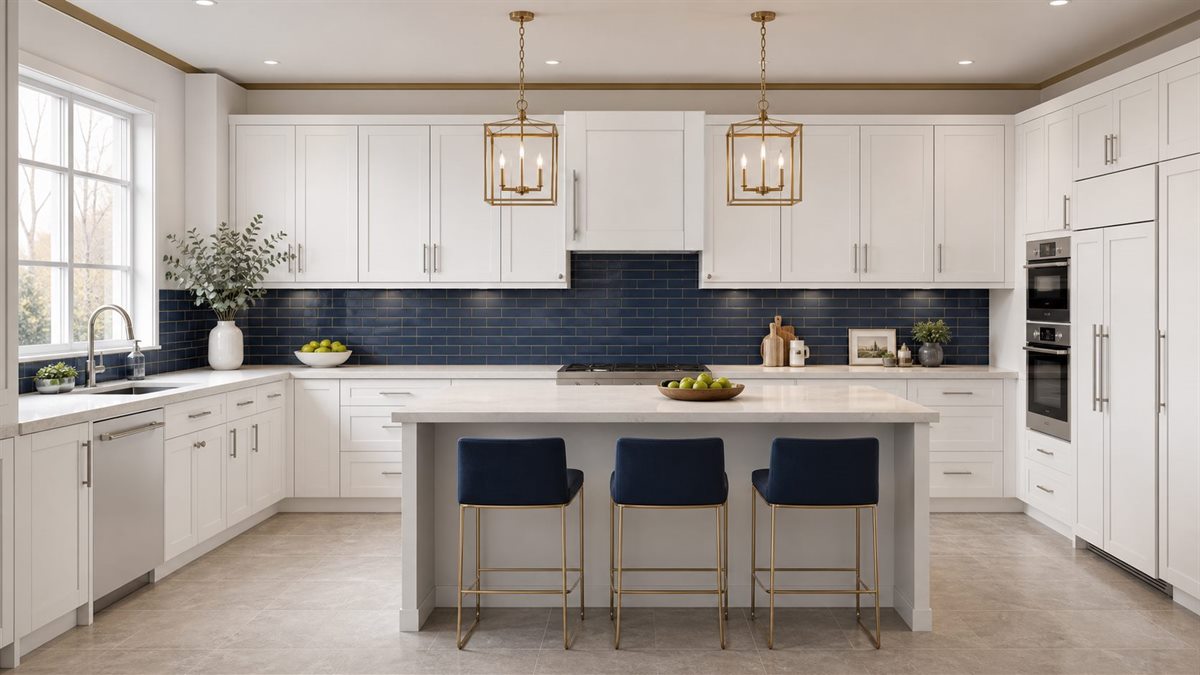
Almost every cabinet in a kitchen is built to the same short menu of standard sizes — and once you know that menu, planning a layout stops feeling like guesswork. The short answer: base cabinets are 34½″ high and 24″ deep, wall cabinets are 12″ deep in 30″, 36″ and 42″ heights, tall pantries run 84″ to 96″, and bathroom vanities are 34½″ high and 21″ deep — with widths stepping in 3-inch increments from 9″ to 48″ across all of them. Everything below is that menu, laid out as tables you can scan, compare and print.
This guide walks through kitchen cabinet sizes the way an installer thinks about them: base, wall, and tall units; their standard widths, heights, and depths; how the 3-inch width grid lets you fill almost any wall; and how each number maps to a cabinet you can actually order. None of these dimensions are brand-specific — they are the standard American kitchen dimensions that countertops, sinks, and appliances are all built around, which is exactly why a well-planned kitchen drops together so cleanly. Where a row names a specific TC Wholesale Cabinetry cabinet, it links straight to that size so you can check the spec rather than take the number on trust.
What are standard base cabinet sizes?
Standard base cabinets are 34½ inches tall and 24 inches deep, and they run from 9 to 48 inches wide in 3-inch increments. Add a countertop and the finished work surface lands at the familiar 36-inch height. These standard base cabinet dimensions are an industry convention rather than a single maker's spec, which is why they pair with off-the-shelf counters, sinks, and dishwashers without custom fitting.
The 34½-inch box height is deliberate. It leaves room for a ¾-inch to 1½-inch countertop and brings the work surface to roughly 36 inches — the height most people find comfortable for chopping, mixing, and standing at a sink. Depth is just as standardized: a 24-inch box plus a counter overhang gives you a finished countertop depth of about 25½ inches, which is exactly what a standard slide-in range and a drop-in sink are sized to meet. Hold any of these numbers as fixed, and the rest of the kitchen falls into place around them.
Width is where the planning happens. Base cabinets step in 3-inch increments — 9, 12, 15, 18, 21, 24, 30, 36, 42, 48 — so you assemble a run from a handful of standard boxes and bridge whatever's left over with a narrow filler strip. A typical kitchen leans on a few workhorse widths: a 36-inch sink base under the window, a 30- or 36-inch base beside the range, and a 15- or 18-inch drawer base for utensils. Sink base cabinet sizes usually start at 30 inches and climb to 36 inches to clear the bowl and plumbing, with a 33-inch unit common under an apron-front farmhouse sink.
- Standard base — single-door units from 9 to 21 inches; double-door units from 24 to 48 inches; all 34½ inches tall and 24 inches deep.
- Sink base — 30 to 36 inches wide with a false drawer front, built to clear the bowl and supply lines (33 inches is the usual farmhouse-sink width).
- Drawer base — 15, 18, 24, or 30 inches wide, stacked with three or four drawers for pots, utensils, and pantry goods.
- Corner base — blind-corner and lazy-Susan units that turn the inside corner without leaving dead space.
Base cabinet size chart
Here is the base run as a chart. The first row is the industry standard every base cabinet is built to; each row after it is a size you can order, linked to its spec.
| Base cabinet | Width | Height | Depth | What it is for |
|---|---|---|---|---|
| Standard base (industry spec) | 9″–48″ in 3″ steps | 34½" | 24″ | Countertop lands at about 36″ once a counter is added |
| 15-inch Shaker base cabinet | 15″ | 34½" | 24″ | Single door — narrow runs and the end of a wall |
| 18-inch Shaker base cabinet | 18″ | 34½" | 24″ | Single door — the common narrow utility width |
| 18-inch Shaker drawer base cabinet | 18″ | 34½" | 24″ | Drawer stack for utensils and small tools |
| 24-inch Shaker drawer base cabinet | 24″ | 34½" | 24″ | Drawer stack for pots and pans beside the range |
| 30-inch Shaker base cabinet | 30″ | 34½" | 24″ | Double door — the workhorse width beside a range |
| 33-inch Shaker farmhouse sink base cabinet | 33″ | 34½" | 24″ | Apron-front (farmhouse) sink |
| 36-inch Shaker base cabinet | 36″ | 34½" | 24″ | Widest standard double-door base |
| 36-inch Shaker sink base cabinet | 36″ | 34½" | 24″ | Drop-in sink, bowl and supply lines |
| 36-inch Shaker lazy Susan base cabinet | 36″ | 34½" | 24″ | Inside corner — rotating shelf brings the back to your hand |
| 39-inch Shaker blind corner base cabinet | 39″ | 34½" | 24″ | Inside corner — one section tucks behind the adjacent run |
Every one of these widths is on the base cabinet catalog, each built to the same all-plywood box with solid-wood Shaker doors and soft-close hardware, so a sink base and a drawer base read as one continuous run rather than a set of mismatched boxes. Because the sizes are standard, you can swap one configuration for another on the same wall without redrawing the whole layout — a 30-inch Shaker base cabinet and a 24-inch Shaker drawer base cabinet occupy the same height and depth, so trading one for the other changes only what is behind the door.
What are standard wall cabinet sizes?
Standard wall cabinets are 12 inches deep and come in three common heights — 30, 36, and 42 inches — plus short 12-to-18-inch units that sit above a range or refrigerator. Widths follow the same 9-to-48-inch, 3-inch grid as base cabinets. The chosen height sets how far the cabinets run up the wall and whether they meet the ceiling or stop below a soffit.
Picking among the standard wall cabinet heights is mostly a question of ceiling height and how much storage you want overhead. A 30-inch wall cabinet, mounted with its top at 84 inches, leaves a soffit gap above on an 8-foot ceiling — the traditional look. A 36-inch cabinet closes most of that gap, and a 42-inch cabinet runs nearly to an 8-foot ceiling for full-height storage with no dust-collecting soffit. Wall cabinets are typically hung so the bottom sits 18 inches above the countertop, which keeps the first shelf within easy reach and leaves working room for small appliances underneath.
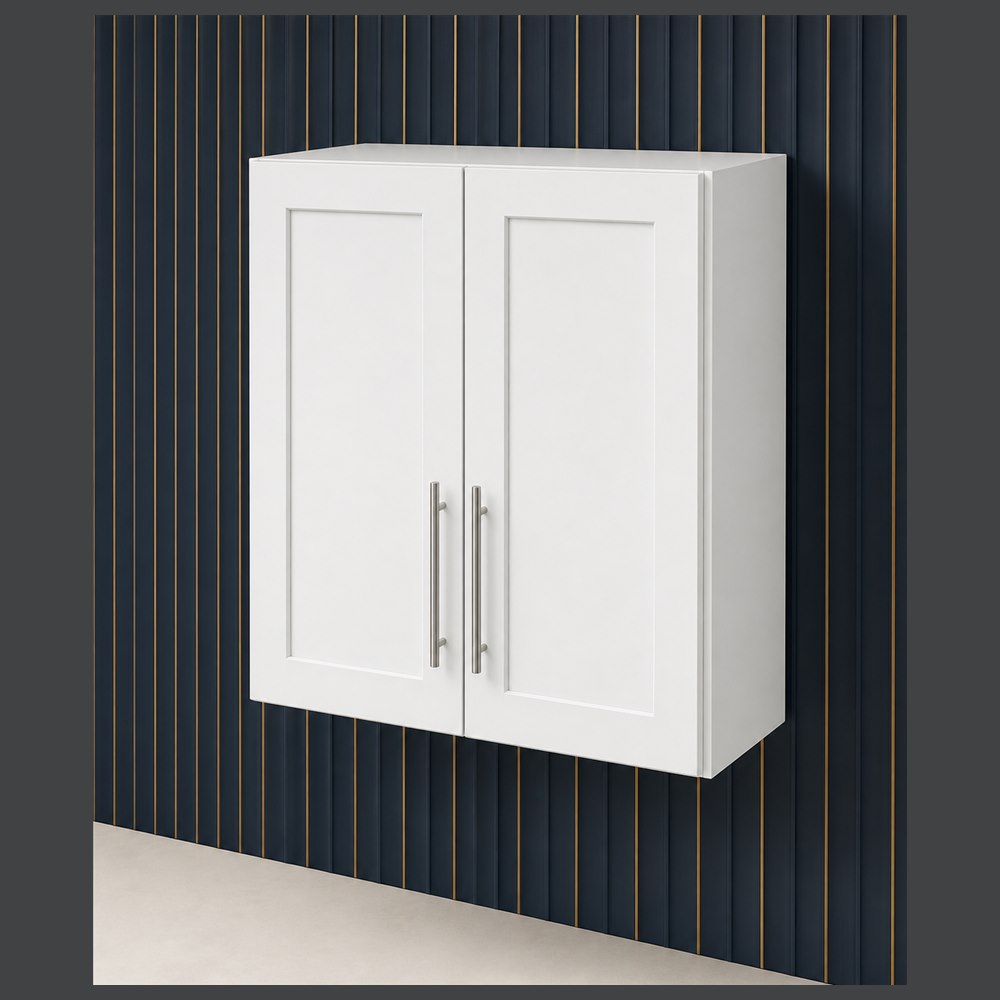
The shallow 12-inch depth is what keeps wall cabinets from crowding the person at the counter, and it is why a wall cabinet feels so much lighter than the 24-inch base below it. Over a refrigerator or range hood, a short 12-, 15-, or 18-inch-tall cabinet bridges the gap to the ceiling and adds storage for trays and seldom-used gear. Glass-door fronts in the same Shaker profile let you break up a long upper run without changing the dimensions.
Wall cabinet size chart
| Wall cabinet | Width | Height | Depth | What it is for |
|---|---|---|---|---|
| Standard wall (industry spec) | 9″–48″ in 3″ steps | 30″, 36″ or 42″ | 12″ | Hung so the bottom sits about 18″ above the countertop |
| 18-inch Shaker wall cabinet | 18″ | 30″ | 12″ | Single door — narrow gaps and run ends |
| 24-inch Shaker wall cabinet | 24″ | 36″ | 12″ | Double door — everyday dish storage |
| 30-inch Shaker wall cabinet | 30″ | 36″ | 12″ | Double door — the common width over a counter run |
| 36-inch Shaker wall cabinet | 36″ | 36″ | 12″ | Widest standard double-door wall unit |
| 24-inch Shaker corner wall cabinet | 24″ | 30″ | 12″ | Diagonal corner — turns the upper run without a collision |
| 24-inch Shaker glass-door wall cabinet | 24″ | 42″ | 12″ | Glass front — breaks up a long upper run |
| 30-inch Shaker glass-door wall cabinet | 30″ | 42″ | 12″ | Glass front at full 42″ height for a 9-foot ceiling |
| 36-inch Shaker glass-door wall cabinet | 36″ | 36″ | 12″ | Widest glass front — a display run over a long counter |
A practical way to read that chart: pick the height first from your ceiling, then fill the widths. On an 8-foot ceiling most runs use 30″-high boxes — an 18-inch Shaker wall cabinet at the end of a run, a 30-inch Shaker wall cabinet over the main counter. On a 9-foot ceiling the 42″ heights close the gap to the crown. You can see every height and width on the wall cabinet catalog, all built to match the base and tall lines.
How tall are pantry and tall cabinets?
Tall and pantry cabinets stand 84, 90, or 96 inches tall and are usually 24 inches deep, matching the base run. The 84-inch height aligns with the top of standard wall cabinets on an 8-foot ceiling; 90 and 96 inches reach toward 9-foot ceilings for floor-to-ceiling storage. The right tall pantry cabinet height is simply the one that matches your ceiling and the top of your wall cabinets, so the run reads as one clean line.
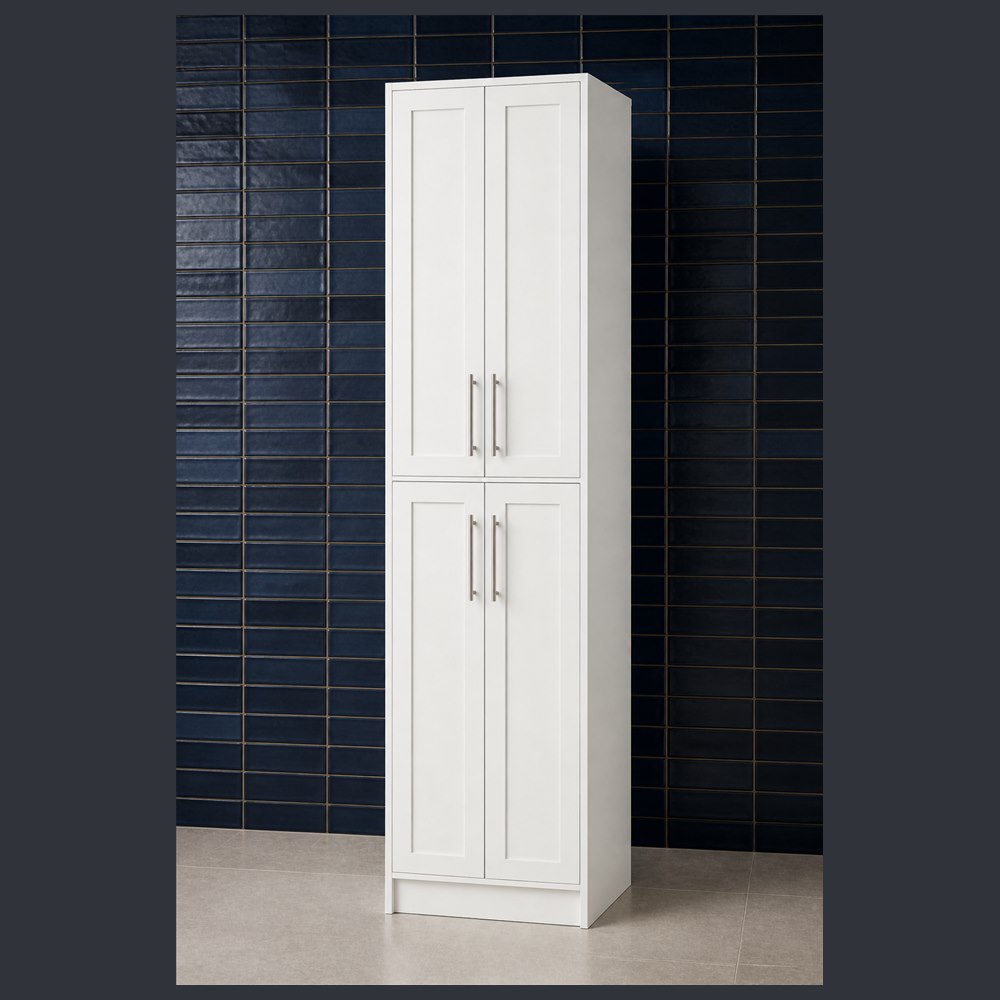
Pantry cabinets earn their keep by turning vertical space into usable, adjustable shelving. A full-depth 24-inch pantry holds the same volume as a small closet and anchors the end of a kitchen run, a laundry wall, or a garage drop zone. Common widths are 15, 18, 24, and 30 inches; at 24 inches deep they sit flush with the base cabinets so the counter doesn't have to jog around them. Because the doors and finish match the rest of the line, a tall cabinet reads as part of the kitchen rather than a bolted-on closet.
Tall and pantry cabinet size chart
| Tall / pantry cabinet | Width | Height | Depth | What it is for |
|---|---|---|---|---|
| Standard tall (industry spec) | 15″–36″ | 84″, 90″ or 96″ | 24″ | 84″ suits an 8-foot ceiling; 90″ and 96″ suit a 9-foot ceiling |
| 15-inch Shaker pantry cabinet | 15″ | 84″ | 24″ | Narrow pantry that caps the end of a run |
| 18-inch Shaker pantry cabinet | 18″ | 84″ | 24″ | Broom and utility storage |
| 24-inch Shaker pantry cabinet | 24″ | 84″ | 24″ | Full-depth food pantry, flush with the base run |
| 24-inch Shaker tall pantry cabinet | 24″ | 96″ | 24″ | Floor-to-ceiling storage on a 9-foot ceiling |
| 30-inch Shaker pantry cabinet | 30″ | 90″ | 24″ | Wide pantry sized between 84″ and 96″ |
| 30-inch Shaker tall pantry cabinet | 30″ | 96″ | 24″ | The largest pantry in the line |
Reading it by ceiling height is the quickest route. An 8-foot ceiling wants the 84″ units — a 24-inch Shaker pantry cabinet lines its top up with 30″ wall cabinets so the whole upper edge of the kitchen sits on one level. A 9-foot ceiling can take the 96″ boxes, where a 24-inch Shaker tall pantry cabinet gives genuine floor-to-ceiling storage. The full range of heights and widths lives on the tall and pantry catalog.
One planning note on the tallest units: a 96-inch cabinet is a big, heavy box, and on a 9-foot ceiling it gives you genuine floor-to-ceiling storage, but you'll want the upper shelves paired with a step stool for daily use. On a standard 8-foot ceiling, an 84-inch pantry is the natural choice because its top lines up with 30-inch wall cabinets hung at the same height — keeping the whole upper edge of the kitchen on one level.
What are standard cabinet depths?
Depth is the most standardized dimension of all: kitchen base and tall cabinets are 24 inches deep, wall cabinets are 12 inches deep, and bathroom vanity cabinets are typically 21 inches deep. These depths almost never change, because countertops, sinks, ranges, and plumbing rough-ins are all engineered to meet them. Width and height give you choices; depth mostly gives you a constant to build around.
The reasons behind each depth are practical. A 24-inch base depth plus a 1-to-1½-inch counter overhang lands the finished countertop at about 25½ inches — exactly what a slide-in range and a standard sink expect. A 12-inch wall depth keeps the uppers from looming over the work zone while still fitting dinner plates on edge. And the shallower 21-inch vanity depth suits a bathroom, where floor space is tighter and the plumbing footprint is smaller.
Bathroom vanity size chart
Vanities run a little differently from kitchen base cabinets: same 34½-inch height, but 21 inches deep instead of 24, and widths that climb past the kitchen grid to 60 inches for a double sink.
| Vanity cabinet | Width | Height | Depth | What it is for |
|---|---|---|---|---|
| Standard vanity (industry spec) | 24″–60″ | 34½" | 21″ | Shallower than a kitchen base so a bathroom keeps floor space |
| 18-inch Shaker vanity drawer base cabinet | 18″ | 34½" | 21″ | Drawer bank beside a sink cabinet |
| 24-inch Shaker vanity cabinet | 24″ | 34½" | 21″ | Single sink — powder rooms and tight baths |
| 30-inch Shaker vanity cabinet | 30″ | 34½" | 21″ | Single sink — the common secondary-bath width |
| 36-inch Shaker vanity cabinet | 36″ | 34½" | 21″ | Single sink with usable counter either side |
| 48-inch Shaker vanity cabinet | 48″ | 34½" | 21″ | Single sink with full drawer storage |
| 60-inch Shaker double vanity cabinet | 60″ | 34½" | 21″ | Two sinks in a primary bathroom |
A 30-inch Shaker vanity cabinet is the workhorse of a secondary bathroom, while a 60-inch Shaker double vanity cabinet is what a primary bath needs for two sinks. The full range sits on the bathroom vanity catalog.
Because depth is fixed, it's the dimension you rarely have to think about once a layout is underway — which is a good thing. It means a sink base from one part of the run and a drawer base from another sit at the same projection, the counter installs in a straight line, and the toe-kick runs unbroken along the floor. The constants are what make the variables manageable.
How do filler strips and corner cabinets fit?
Filler strips and corner cabinets solve the two places where a grid of standard boxes can't quite reach: leftover inches along a wall, and the dead space where two runs meet at an inside corner. A filler is a narrow flat strip — usually 3 or 6 inches wide — that bridges a gap. A corner cabinet is a purpose-built box, either a blind corner or a lazy Susan, that turns the corner and keeps the space behind it usable.
Fillers do quiet but essential work. Because cabinets only come in 3-inch width steps, a wall that measures, say, 10 feet 4 inches won't divide evenly into standard boxes — so you fill the run with the nearest standard widths and absorb the remaining couple of inches in a filler strip. Fillers also create clearance so a door or drawer can open fully next to a wall, an appliance, or an adjacent cabinet that would otherwise bind. They are cut to size on site and finished to match, so they disappear into the run.
- Filler strips — 3- or 6-inch flat pieces that take up leftover wall length and provide door- and drawer-clearance at walls and appliances.
- Blind-corner base — a wider box (often 39 or 42 inches) where one section tucks out of sight behind the adjacent run to work an inside corner.
- Lazy-Susan base — a corner unit with a rotating shelf that brings the back of the corner to your hand instead of leaving it as dead space.
Inside corners are the other classic puzzle. Run two cabinets straight into a corner and the boxes collide, or you lose access to everything behind the join. A blind-corner cabinet deliberately hides part of its width behind the neighboring run; a lazy-Susan spins that buried space out to you. Both are standard catalog items, not custom work: the 39-inch Shaker blind corner base cabinet and the 36-inch Shaker lazy Susan base cabinet sit in the base cabinet lineup alongside the straight runs, at the same 34½″ height and 24″ depth. Upstairs, a 24-inch Shaker corner wall cabinet does the same job for the upper run.
How do I map these sizes to a real cabinet?
Mapping sizes to cabinets is a four-step loop: measure each wall, mark the fixed points (sink, range, refrigerator, windows), fill the runs with standard widths from largest to smallest, and absorb the remainder with fillers and corner units. Work base, then wall, then tall — and lean on the 3-inch grid so the boxes you choose are ones you can actually order off the shelf.
Start with the anchors that can't move. The sink usually wants a 30-to-36-inch sink base under the window — a 36-inch Shaker sink base cabinet for a standard drop-in bowl, or a 33-inch Shaker farmhouse sink base cabinet if you are fitting an apron front. The range and refrigerator each claim a standard opening; then you fill the space between them with the widest standard cabinets that fit and step down to narrower boxes as you approach a wall or corner. Wall cabinets generally mirror the base layout above the counter, and a tall pantry caps the end of a run. If a number doesn't land cleanly on the grid, that's what a filler is for — you don't need a custom box, just a strip cut to size.
The one step worth doing carefully is the measuring itself, because every width you choose depends on it. Our companion guide on how to measure a kitchen for cabinets walks through wall lengths, ceiling height, and where to mark plumbing and outlets so your sizes come out right the first time. And if you want to see how these standard dimensions translate into a finished, ready-to-assemble kitchen, our guide to ready-to-assemble Shaker cabinets covers how the same size grid ships flat and goes together on site.
From there, the catalog does the rest. Browse the full lineup by category — base, wall, tall and pantry, and vanity — on the cabinet catalog, where each unit lists its exact width, height, and depth. Not sure which widths add up to your wall? Send your measurements with a free quote request and the sizes get specified for you, filler strips and corner units included.
Frequently asked questions about cabinet sizes
What is the standard base cabinet height?
A standard base cabinet is 34½ inches tall without a countertop. Adding a ¾-inch to 1½-inch counter brings the finished work surface to roughly 36 inches, which is the height dishwashers, slide-in ranges and standard sinks are all designed around.
How deep are kitchen cabinets?
Kitchen base and tall cabinets are 24 inches deep; wall cabinets are 12 inches deep; bathroom vanities are 21 inches deep. Depth is the least negotiable dimension in a kitchen because appliances, sinks and plumbing rough-ins are all built to meet it — a 24-inch base plus a counter overhang lands the finished countertop at about 25½ inches.
What widths do kitchen cabinets come in?
Widths step in 3-inch increments from 9 to 48 inches — 9, 12, 15, 18, 21, 24, 27, 30, 33, 36, 42, 48. Single-door base cabinets generally run 9 to 21 inches and double-door units 24 inches and up. Any leftover wall length is absorbed by a 3- or 6-inch filler strip rather than a custom-width box.
How tall are wall cabinets, and how high should they hang?
Wall cabinets come in 30, 36 and 42-inch heights, plus short 12-to-18-inch units for above a range or refrigerator. They are typically hung so the bottom edge sits 18 inches above the countertop, which keeps the first shelf in easy reach and leaves working room for small appliances underneath. On an 8-foot ceiling a 30-inch cabinet leaves a soffit gap; a 42-inch cabinet runs nearly to the ceiling.
What size cabinet goes under a kitchen sink?
A sink base is usually 30 to 36 inches wide, sized to clear the bowl and the supply and drain lines behind it. A 33-inch unit is the common width under an apron-front farmhouse sink. Sink bases carry a false drawer front rather than a working drawer, because the bowl occupies that space.
How tall is a pantry cabinet?
Tall and pantry cabinets stand 84, 90 or 96 inches tall at 24 inches deep. Choose 84 inches on a standard 8-foot ceiling so the top lines up with 30-inch wall cabinets, and 90 or 96 inches on a 9-foot ceiling for floor-to-ceiling storage. Widths are commonly 15, 18, 24 and 30 inches.
Are cabinet sizes the same across brands?
The core dimensions are, and that is deliberate. The 34½-inch base height, 24-inch base depth, 12-inch wall depth and 3-inch width grid are industry conventions that countertops, appliances and sinks are engineered around, so boxes from different makers land at the same projection. What does vary between brands is the box material, the door style, the hardware and the exact list of widths each line actually stocks — which is why it is worth checking a real spec sheet rather than assuming.
Have your wall measurements ready? Send them over and we'll map them to standard cabinet sizes and price the run — request a free quote and we'll take it from there.
Keep reading
- Base Cabinet Sizes & Types: Standard Dimensions Explained
Every base cabinet is 34½ inches high and 24 inches deep — width is the only variable. Here are the standard widths and the six types that cover almost every kitchen, each linked to a real cabinet spec.
- Wall Cabinet Sizes & Heights: Standard Dimensions Explained
Wall cabinets are 12 inches deep and come in 30, 36, and 42-inch heights — pick by ceiling height, not taste. Here are the standard sizes, the types that matter, and how high to hang them.
- Tall Pantry Cabinet Sizes: 84, 90 & 96-Inch Guide
Tall pantries come in three heights — 84, 90, and 96 inches — and the ceiling picks for you. Here is how to match height, align tops with wall cabinets, and choose width without wasting inches.
- Bathroom Vanity Sizes: 24 to 60-Inch Guide
Vanities are kitchen base cabinets narrowed to 21 inches deep — same 34½-inch height, widths from 24 to 60 inches. Here is which width fits which bathroom, single vs double sink, and the small-bath tricks.
- How to Measure Your Kitchen for New Cabinets
A clear, repeatable way to measure your kitchen for new cabinets — wall-to-wall lengths, where to mark windows, doors, outlets, and appliances, and the working clearances that keep a layout livable.
- Ready-to-Assemble Shaker Cabinets: The Complete Guide
Why the five-piece Shaker door stays the safe, timeless choice — and how ready-to-assemble Shaker cabinets deliver it factory-direct, in white and gray.
- 10x10 Kitchen Cabinet Cost: What the Quote Means
A 10×10 quote is the industry's apples-to-apples yardstick: one sample layout, cabinets only. Here is what it includes, what it leaves out, and the third-party ranges to hold any quote against.
- What Affects Your RTA Cabinet Quote? A Cost Guide
An RTA cabinet quote is a parts list with a price attached — boxes, doors, finish, hardware, accessories, and freight. Here is what each line means, what moves the total, and how to compare quotes fairly.
- Kitchen Cabinet Cost Per Linear Foot Explained
Per-linear-foot pricing divides the cabinet total by the wall length the cabinets cover — but quotes disagree on what a foot includes. Here is how to measure, what to ask, and current third-party ranges by tier.
- Small Kitchens, Standard Cabinets: Sizes That Fit
A small kitchen does not need custom boxes — it needs the narrow end of the standard menu. Here are the widths, heights, and corner units that make tight layouts work, each linked to a real cabinet spec.
- Kitchen Cabinet Layouts and Fillers: L, Galley, U
Pick the layout that fits your room — L-shape, galley, or U-shape — then plan the filler strips that make stock cabinet widths fit wall to wall without binding doors or drawers.
- Corner Cabinets and Lazy Susans: Sizes That Work
The corner is where kitchens lose storage. Here is how blind corners, lazy susans, and easy-reach cabinets compare on size, access, and cost — and which one fits your layout.
Ready to plan your kitchen?
Send us your layout for a free, no-obligation quote, or browse the full factory-direct catalog of all-plywood Shaker cabinets.