
Ready-to-Assemble Shaker Cabinets: The Complete Guide
By TC Wholesale Cabinetry · Editorial team
June 26, 2026 · 9 min read
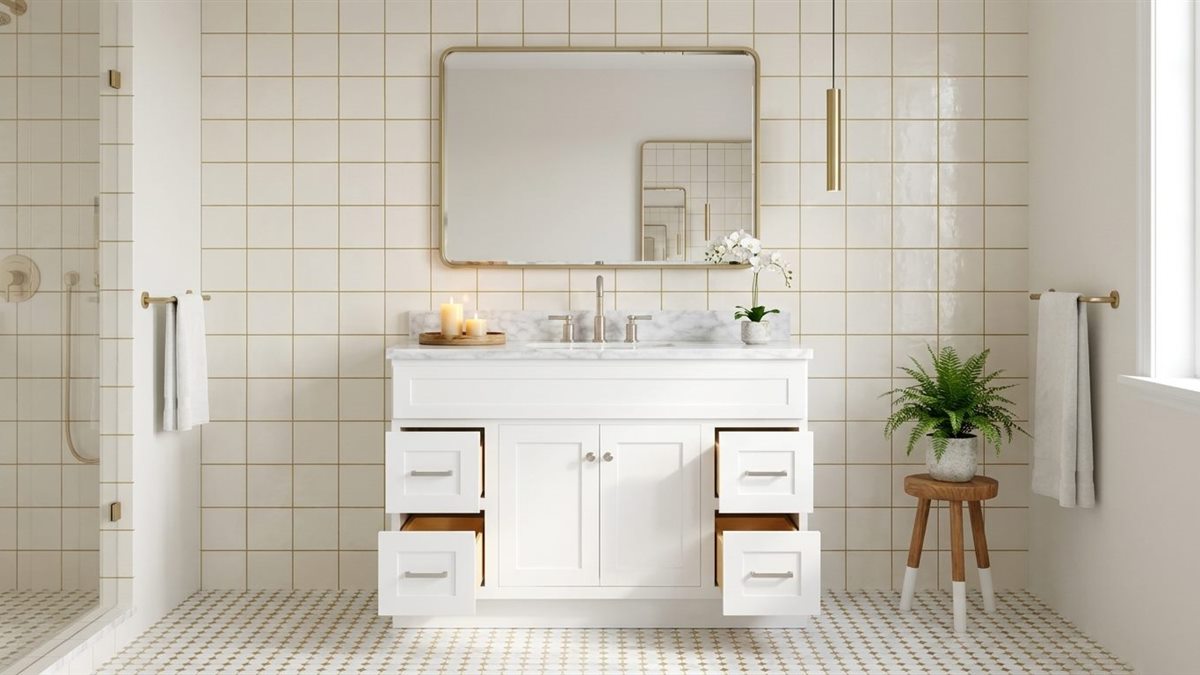
If you have looked at kitchen cabinets for more than five minutes, you have already met the Shaker door — the simple flat-panel front that shows up in roughly every other remodel photo. This guide answers the questions buyers actually ask: what makes a door Shaker, why the style refuses to go out of fashion, how white and gray compare, what sizes you can order, and how ready to assemble shaker cabinets deliver the look factory-direct without a custom-shop bill.
What is a Shaker cabinet?
A Shaker cabinet is one fronted by the classic five-piece door: four flat frame pieces — two vertical stiles and two horizontal rails — surrounding a single recessed flat center panel. No carving, no raised molding, no applied trim. The style takes its name from the Shakers, a 19th-century religious community whose furniture prized function and honest joinery over ornament. That restraint is exactly why the door still looks current today.
The five-piece build is the whole story, and the honest answer to what is a Shaker cabinet comes down to that frame-and-panel construction. The flat panel floats in a groove cut into the surrounding frame, so the wood can expand and contract with humidity without cracking — a quietly practical detail the Shakers worked out two centuries ago. On a solid-wood Shaker door, that frame is milled from real hardwood, giving the crisp, square inside edge you can feel with a fingertip. The square shoulders where each rail meets each stile are the visual signature of the style: clean joints with no decorative profile to soften them.
Set it against an ornate raised-panel door — busier, more traditional, with a contoured center that catches both light and cooking grease — or against a flat slab door that reads fully modern and a little austere, and Shaker sits comfortably in the middle. There is enough shadow line around the recessed panel to feel substantial and built-to-last, but none of the fussy detail that dates a kitchen or traps residue over a working range. That middle position is why designers reach for it in nearly every kind of home, from a city loft to a farmhouse.
Why is Shaker the most popular kitchen cabinet style?
Shaker is the most-installed cabinet door in America because it is the rare design that fits almost everywhere. The flat panel and square frame read as modern in a minimalist kitchen and as classic in a farmhouse or transitional one. It photographs well, resells well, and pairs with nearly any countertop, hardware, or backsplash — which makes it the low-risk default for homeowners, remodelers, and builders alike.
A few concrete reasons it keeps winning, year after year and trend after trend:
- Versatility — the same door works in modern, transitional, farmhouse, and traditional kitchens; only the paint color and hardware change.
- Resale value — a neutral Shaker kitchen appeals to the widest pool of buyers and rarely reads as dated on the listing photos.
- Hardware-flexible — bar pulls lean contemporary, cup pulls and knobs lean classic, and the door takes either without argument.
- Easy upkeep — the flat recessed panel wipes clean and hides everyday wear better than a heavily molded face.
- Pairs with everything — quartz or butcher block, brass or matte black, a quiet backsplash or a loud one; the door stays the calm element in the room.
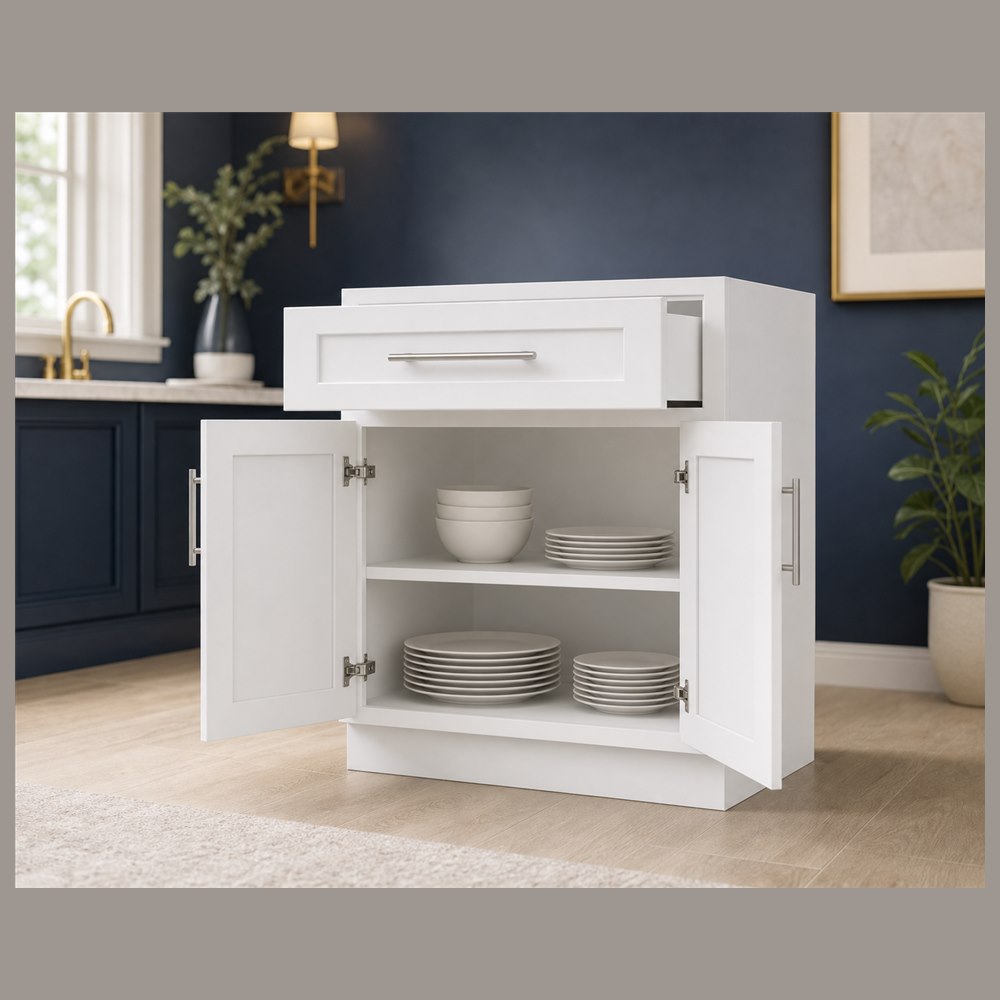
There is a design-history reason underneath the popularity, too: because the original Shaker furniture was made to be useful before it was made to be admired, the door never carried the era-specific flourishes that tie a kitchen to a single decade. A 1990s oak raised panel screams its age; a Shaker door from the same year just needs paint. That timelessness is what every magazine spread is quietly borrowing.
That broad appeal is also why the style pairs so naturally with flat-pack pricing — a simple, repeatable door is exactly the kind of thing a factory can build consistently and ship flat. If you are weighing the format itself rather than the door, our guide on whether RTA cabinets are worth it walks through the real trade-offs of buying ready-to-assemble.
What does "ready-to-assemble Shaker" get you?
Ready-to-assemble Shaker cabinets give you the same five-piece door and sturdy box as a pre-built cabinet, shipped flat to cut freight and assembled on-site with a screwdriver. At TC that means an all-plywood box — no particleboard — paired with solid-wood Shaker doors, soft-close hinges, and undermount drawer glides, sold factory-direct without a showroom markup.
Flat-packing is what makes the math work. A pre-assembled cabinet is mostly air, so you pay to ship empty space and warehouse bulky finished boxes; RTA Shaker kitchen cabinets instead arrive as labeled, pre-drilled panels that take a few minutes each to put together with a screwdriver and a rubber mallet. Crucially, the construction underneath is not downgraded to hit a lower price. Every TC box is built from plywood using CARB P2-compliant materials, the doors are solid wood rather than a printed foil, and the motion hardware is soft-close throughout. To understand why the box material matters as much as the door face, read our breakdown of plywood versus particleboard cabinet boxes.
The assembly itself is closer to flat-pack furniture than to carpentry: the panels are cut and bored at the factory, the hardware is included, and a handy homeowner or any installer can put a kitchen's worth together over a weekend. Because the parts are machined to fit, the finished box is just as square and rigid as a pre-built one — you are saving on freight and labor, not on the cabinet.
You can see every Shaker configuration — base, wall, tall, and vanity — on the cabinet catalog, each unit shipped ready to assemble and finished to match across the line so a sink base and a wall cabinet read as one kitchen, not a mismatch. Because the doors and finishes are standardized, you can mix unit types freely and still get a single, coherent look once everything is installed.
White vs. gray Shaker — which finish should you pick?
White Shaker is the brighter, more timeless pick; gray Shaker feels a touch warmer and hides everyday smudges a little better. TC offers both in the identical five-piece door: Purity White, a clean near-white, and Victory Gray, a soft mid-tone greige. White makes a small kitchen feel larger and more open; gray grounds a big, light-filled room. In almost every case, neither finish will look dated five years from now.
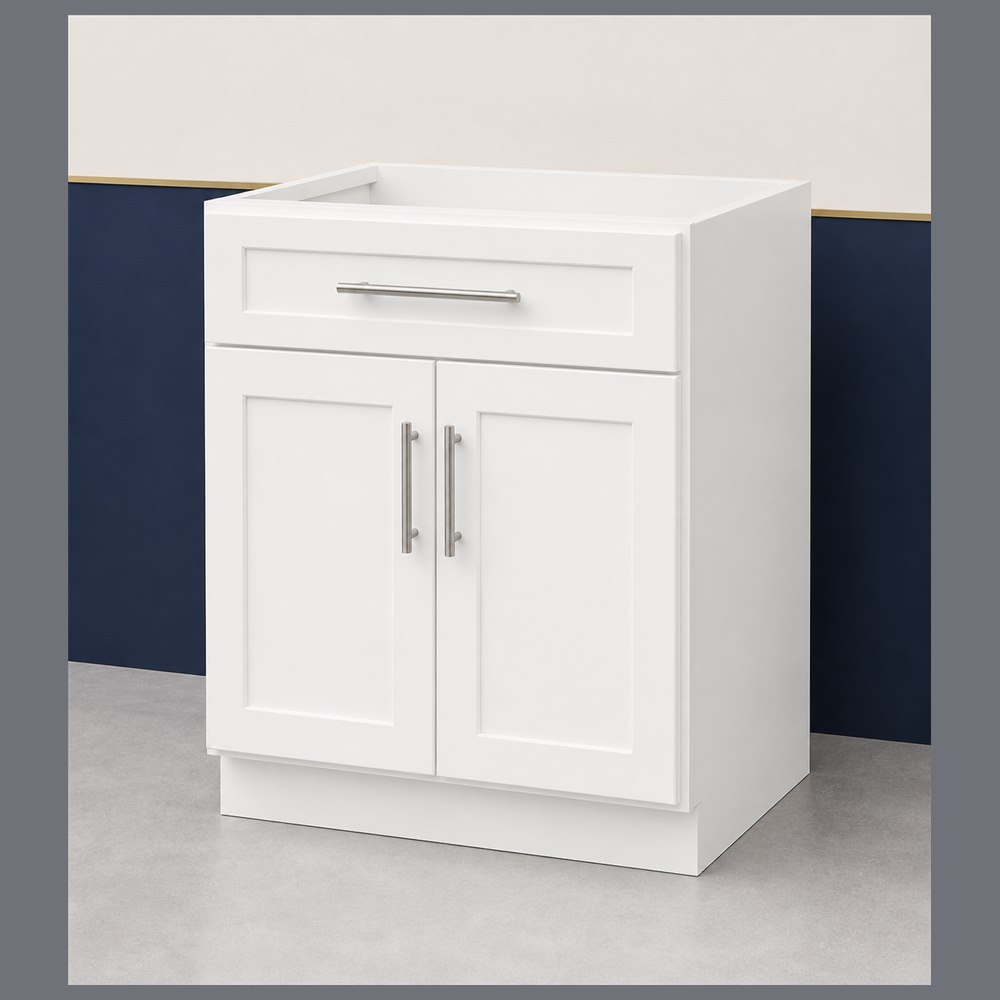
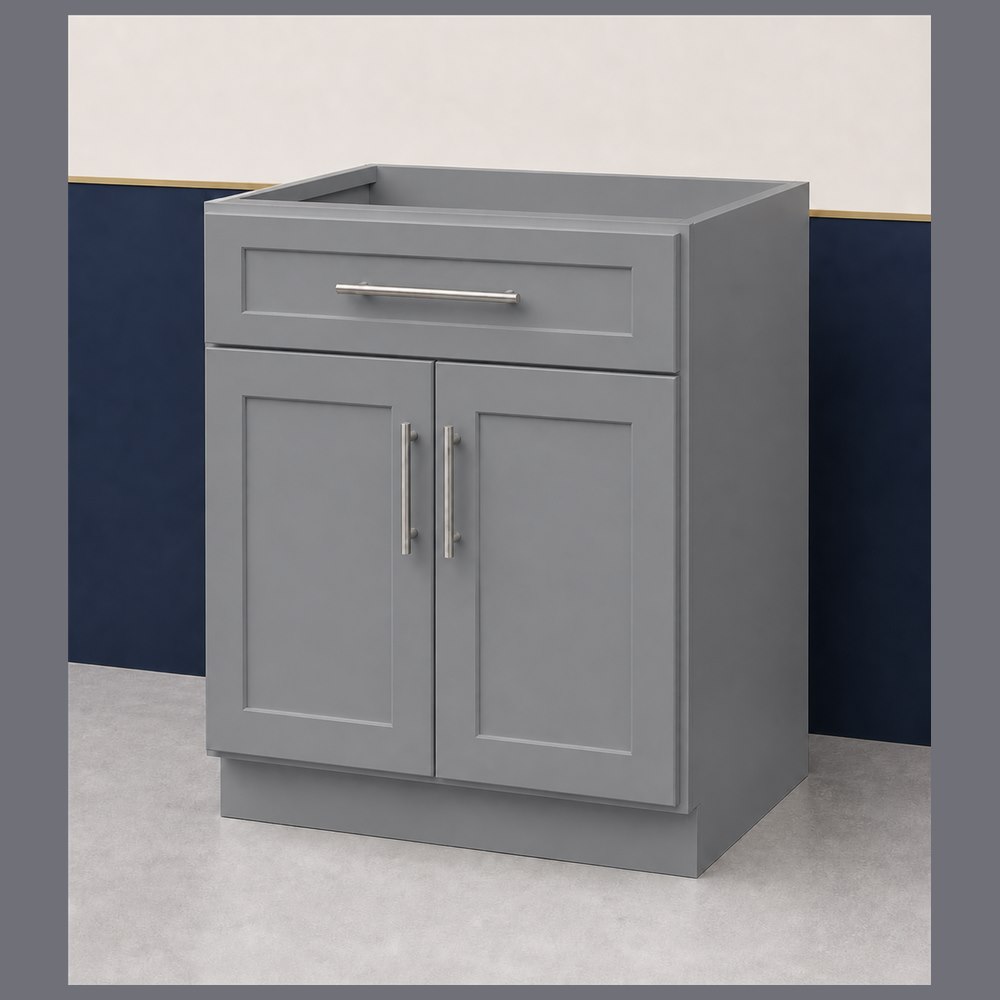
Choose RTA white Shaker cabinets when you want maximum brightness, the most resale-safe option, or a backdrop that lets a bold countertop or backsplash lead. Choose RTA gray Shaker cabinets when an all-white kitchen feels too clinical, when you want a little more depth, or when heavy family traffic makes fingerprints a fact of life — gray (spelled grey outside the US) shrugs off smudges that show instantly on a bright white door. A third route is to use both: white wall cabinets over gray or greige base cabinets has been one of the most popular two-tone looks of the past decade, and planning it costs nothing extra.
We weigh the two finishes side by side — undertones, lighting, hardware pairings, resale — in our white vs. gray Shaker comparison. But the surest way to decide is to see the finish in your own light: kitchen lighting shifts a color more than any screen can show, so order a door sample of each before you commit a whole kitchen to one.
What sizes do RTA Shaker cabinets come in?
RTA Shaker cabinets follow standard American kitchen dimensions, so they drop into existing layouts and pair with off-the-shelf countertops. Base cabinets run 9 to 48 inches wide at 34½ inches tall and 24 inches deep; wall cabinets are 12 inches deep in 30- to 42-inch heights; tall pantries reach 84 to 96 inches; vanities span 24 to 60 inches. Widths step in 3-inch increments, so you can fill almost any wall.
- Base cabinets — 9 to 48 inches wide, 34½ inches tall, 24 inches deep, including sink, farmhouse, drawer, blind-corner, and lazy-Susan units.
- Wall cabinets — 12 inches deep, 30 to 42 inches tall, with solid-door and glass-door fronts to match the same Shaker frame.
- Tall and pantry cabinets — 84, 90, and 96 inches tall to suit standard and 9-foot ceilings for full-height storage.
- Bathroom vanities — 24 to 60 inches wide in single and double configurations, built to the same all-plywood box standard.
Most kitchens are built around a handful of workhorse widths — a 30-inch Shaker base cabinet under the cooktop, a 36-inch Shaker sink base cabinet at the window, and matching wall cabinets above. If you want the full reference, our kitchen cabinet sizes guide breaks down every standard width, height, and depth and where each unit belongs. But you do not need to memorize the catalog: send your wall measurements with a free quote request and the sizes get specified for you.
Are Shaker cabinets out of style?
No. Shaker is not a trend that peaks and fades — industry estimates put the door in continuous use for roughly two centuries, and it remains the default in both new construction and remodels. Because it carries no era-specific ornament, it does not "go out" the way glossy slab fronts or ornate raised-panel doors cycle in and out. Choosing Shaker is about the closest thing to a future-proof cabinet decision you can make.
What actually dates a kitchen is usually the finish, the color, or the hardware — not the shape of the door. That works in Shaker's favor: a five-piece door is a neutral canvas you can refresh years later with new paint or a swap from knobs to bar pulls, without tearing out a single box. Pair that flexibility with a plywood carcass that, in almost every case, outlasts the finish on top of it, and a Shaker kitchen is built to be lived in, not replaced on the next trend. Trends move; a square frame and a flat panel stay put.
How to order RTA Shaker cabinets
Ordering is three steps: browse the catalog, confirm the finish in person, then get a layout-based quote. Pick your sizes and finish in the cabinet catalog, order a door sample so you can judge Purity White or Victory Gray in your own kitchen light, and send your measurements for a free quote. TC ships nationwide, flat-packed, so the same lineup reaches you wherever you are.
- Browse the cabinet catalog to choose your Shaker sizes, configurations, and finish.
- Order a door sample to see the real wood and color before you buy a full kitchen.
- Send your layout with a free quote request and get an itemized, no-obligation price.
Keep reading
- White vs. Gray Shaker Cabinets: How to Choose
Same door, two moods: white Shaker brightens and opens a room, gray Shaker adds depth and forgives smudges. Here's how to choose — and how to see the real finish first.
- Plywood vs. Particleboard Cabinets: Which Lasts Longer?
The box material decides how long a cabinet survives sink leaks, humidity, and years of door slams. Here's the honest plywood-vs-particleboard breakdown.
- Shaker Cabinet Colors: Gray, Cream, Espresso-Look & Wood
White is only the starting point. Here is how gray, cream, espresso-look, and wood-tone Shaker cabinets each behave in a real kitchen — and how to confirm the color before you commit.
- Shaker Cabinet Doors: Profile, Panel, and What to Check
Five pieces make a Shaker door: two rails, two stiles, one recessed panel. Here is what each part does, where quality hides, and what to check when boxes arrive.
Ready to plan your kitchen?
Send us your layout for a free, no-obligation quote, or browse the full factory-direct catalog of all-plywood Shaker cabinets.