
Espresso Shaker Cabinets: Dark, Warm & Timeless
By TC Wholesale Cabinetry · Editorial team
September 9, 2026 · 8 min read
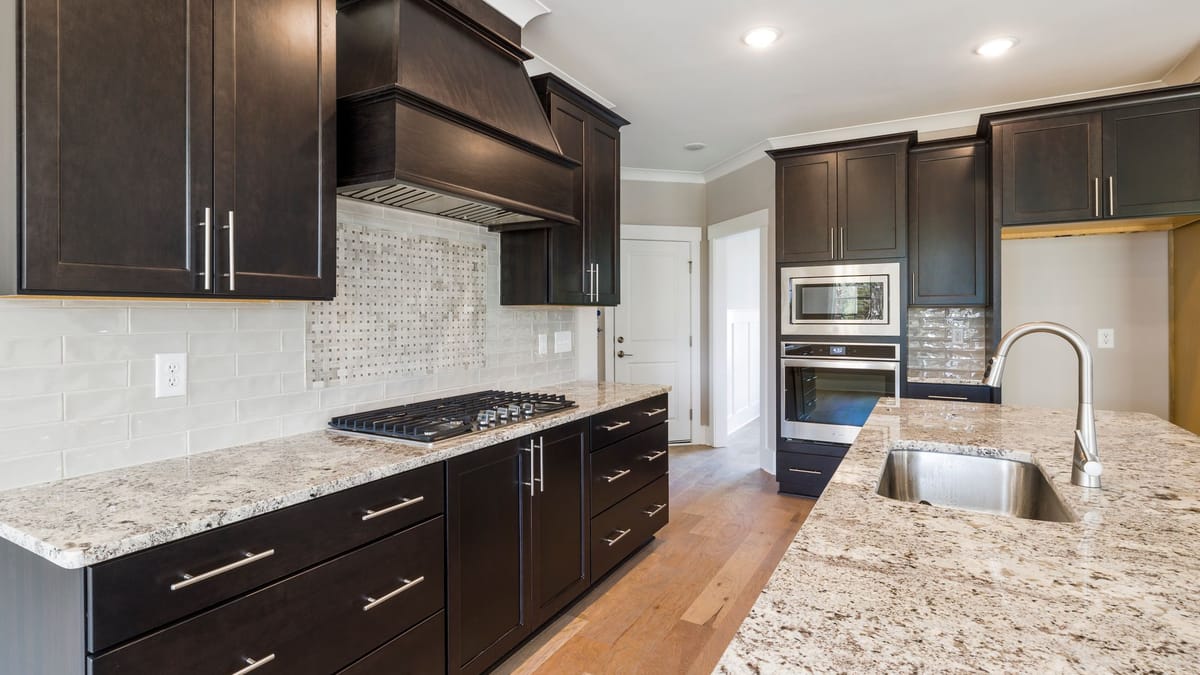
The short answer: espresso Shaker cabinets are a deep, dark-brown stained Shaker door that adds contrast and warmth — best in kitchens with good light, light countertops, and a pale backsplash to balance them. The Shaker profile keeps the look tailored rather than heavy, and because the finish is a stain rather than paint, the door keeps a hint of wood character even at its darkest.
What exactly is an espresso cabinet finish?
Espresso describes a color, not a species or a door style: a saturated dark brown, the color of roasted coffee beans. In dim light an espresso door reads near-black; where daylight or under-cabinet light hits it, the brown warms up and the wood underneath shows through. That shift is the whole personality of the finish — it is never a flat black, and it never goes cold the way a charcoal or black paint can under cool bulbs.
On a Shaker door the finish behaves especially well, because the five-piece construction — flat center panel, square frame — stays visually quiet and lets the depth of the stain do the talking. And because espresso is a stain rather than an opaque paint, faint grain and tonal variation survive even in the darkest corners of the door, which is exactly what keeps a wall of dark cabinetry from reading like a slab of black laminate. One honest note before you shop: we don't sell a finish called Espresso. If the dark-stained look is what you want here, start with Wood Color, the wood-tone finish in our line, and judge it against your idea of espresso with door samples in your own light — stain depth shifts more between rooms than any photo suggests.
Which kitchens suit espresso Shaker cabinets best?
Espresso earns its keep where there is light to play against it. Kitchens with generous daylight, an open plan that borrows light from adjoining rooms, or a well-planned lighting scheme carry dark cabinetry with ease — the doors anchor the space the way a dark suit anchors a room, and everything pale around them looks brighter by comparison. Larger kitchens, galley kitchens with windows at one or both ends, and open-concept layouts with a light island all belong on the yes list.
The caution cases are just as clear. A small, single-window kitchen with modest ceiling light can feel weighed down by espresso wall-to-wall, because dark doors reflect far less light than cream or light gray. That doesn't rule the finish out — it changes the dosage. Proven ways to get the drama without the heaviness:
- Confine the dark to the base. Espresso or dark-stained base cabinets with light uppers keep the upper half of the room open while the lowers absorb daily wear. A dark island under a light perimeter is the same idea in miniature.
- Keep the surroundings pale. Light countertops, a pale backsplash, and lighter walls or floors do the lifting — they supply the contrast dark doors need. Dark-on-dark, done wall-to-wall, suits only large, bright rooms.
- Plan the lighting early, not after. Daylight first, then layered task lighting — see our under-cabinet lighting guide — because a dark door under a single dim ceiling fixture is where kitchens start to feel cave-like.
If your kitchen sits on the borderline — average size, one modest window — tape dark samples at eye level and live with them for a full day, morning through evening lamplight, before committing. An hour in a showroom never answers a light question; a day in your room does. Our broader color overview in the Shaker cabinet colors guide walks through the lighter alternatives if the test tells you espresso is too much for the space.
What countertops go with espresso cabinets?
The classic, oft-pinned formula exists for a reason: espresso doors plus white or light-veined stone, and the kitchen basically styles itself. Light counters supply the contrast that keeps dark cabinetry crisp, and the pairing works across styles — contemporary with a clean quartz, transitional with a softly veined quartzite, traditional with a honed granite. When in doubt, go lighter than you think; the doors can take it.
- White and light quartz: the safest, highest-contrast partner — bright, low-maintenance, and modern against dark stain. A faint gray or warm-beige vein keeps it from reading stark.
- Quartzite and light granite: natural movement and warmth that flatter the brown in the stain; pick slabs whose background stays clearly light so the contrast survives installation.
- Creamy and warm stones: soften the pairing toward traditional or farmhouse — good with brass hardware and wood floors, though slightly less crisp than a true white.
- Butcher block and wood-look surfaces: workable but demand care — wood-on-dark-wood can turn monotone unless the counter is clearly lighter than the doors and the backsplash stays pale. Test with samples, not hope.
Whatever stone you choose, keep the backsplash quiet so the cabinets remain the story — a simple pale tile or a short slab splash lets the dark-to-light contrast read cleanly. And judge every candidate against your actual door sample and floor: undertones that look identical online separate fast in daylight, which is why the samples step sits upstream of every pairing decision in this guide.
What hardware and fixtures pair with espresso doors?
Dark doors are a generous backdrop — most metal finishes read well against them — so the choice is about mood rather than rules. Brushed nickel and stainless are the long-running defaults: cool, quiet, and matched easily to stainless appliances. Matte black sharpens the look toward modern, though it trades away contrast, so it wants good lighting to keep pulls legible against the doors. Warm metals — brass, champagne bronze, brushed gold — lean traditional and transitional, and they pick up the brown warmth in the stain in a way cool metals don't.
Three practical points travel with any finish you pick. First, keep one metal story through the kitchen — pulls, knobs, faucet, and lighting trim in the same family — because a calm backdrop is what lets dark doors lead. Second, size hardware to the door: the Shaker's wide stiles carry longer bar pulls comfortably, and on deep drawers a pull you can grip with a full hand beats a dainty knob daily. Third, confirm placement before drilling — our knobs vs. pulls guide covers the positioning logic that prevents a wall of slightly-off handles. Picture the combinations on real configurations like the 30-inch Shaker base cabinet and the 30-inch Shaker wall cabinet, the two scales that dominate most kitchens.
How do you maintain dark cabinets — dust, prints, scratches?
Every finish trades one kind of visibility for another, and espresso is no exception. Dark doors show light-colored debris — dust, flour, pet lint — the way white doors show dark scuffs, while fingerprints and grease read less angrily on a dark stain than on a near-white painted door. Households that cook daily usually find this an acceptable bargain, provided the cleaning routine is simple enough to actually happen.
- Dust on a schedule, not on sight. A weekly pass with a dry microfiber cloth keeps buildup from filming over — wipe with the grain, and save damp wiping for sticky spots so moisture never lingers in seams and edges.
- Cleaners stay mild. Warm water with a drop of dish soap on a soft cloth handles nearly everything; skip abrasive pads, scouring powders, and harsh solvents, which dull a stained finish faster than years of cooking will. Dry the area after any wet wipe.
- Treat scratches early and small. Shallow nicks in a dark stain respond well to a matching furniture touch-up marker, applied sparingly and blotted — most disappear to anything but a close inspection. The surviving grain in a stained door further breaks up small dings that a flat painted door would telegraph.
- Ventilate the cooking zone. A range hood that actually vents outside does more for long-term cabinet appearance than any cleaner — grease that never settles never needs scrubbing off.
For the full routine — frequencies, what to avoid on hardware and hinges, and how RTA construction responds to moisture — see our guide to cleaning kitchen cabinets. And if your kitchen runs humid or splash-prone, pair the routine with prevention from our moisture-damage prevention guide; a dark stain forgives a lot, but standing water at the sink base forgives nothing.
Questions homeowners actually ask
Are espresso cabinets too dark for a small kitchen?
Wall-to-wall, they can be — dark doors reflect less light, so a compact or dim kitchen feels smaller in full espresso than in cream or light gray. The proven workarounds are confining the dark to base cabinets or the island, keeping uppers light, and running counters, backsplash, and floors pale. Test with dark samples taped at eye level for a full day before deciding.
Do espresso cabinets show dust and fingerprints?
They show light dust and lint more readily than a mid-tone door, and fingerprints less readily than a near-white one — that is the trade, stated plainly. A weekly dry-microfiber pass plus prompt wipe-ups keeps them presentable without special products, and households with kids and pets often prefer this bargain to the crumb-visibility of white.
What countertop color works best with espresso cabinets?
White or light-veined stone — quartz, quartzite, or light granite — is the pairing with the longest track record, because it supplies the contrast dark doors need. Creamy stones warm the look toward traditional; butcher block can work only if it runs clearly lighter than the doors. Judge finalists against your door sample in your own light.
Do dark cabinets make a kitchen look dated?
Not on a Shaker door — the profile itself is the timeless part, and current kitchen coverage keeps describing warm woods and deep browns as the leading edge while cool all-white recedes. What dates a kitchen is rarely the cabinet color; it is mismatched undertones between doors, counters, and floors, or a lighting plan too dim for the depth of the finish.
Where can I see dark-stained Shaker doors before ordering?
Two places. Browse the wood-tone direction in the cabinet catalog — starting with Wood Color — checking real configurations like the 30-inch Shaker base cabinet. Then order door samples of your shortlist and judge them against your countertop, floor, and hardware at morning, afternoon, and evening light.
Leaning toward the dark side? Walk the wood-tone options in the cabinet catalog, compare them against the lighter readings in our Shaker colors guide and the white vs. gray comparison, and before committing a whole kitchen to any stain, order door samples — the lowest-cost step in the project and the one that removes the guesswork screens can't resolve.
Know your finish and your layout? Send your kitchen measurements and we will price it in the finish you picked — request a free quote and we will take it from there.
Keep reading
- Shaker Cabinet Colors: Gray, Cream, Espresso-Look & Wood
White is only the starting point. Here is how gray, cream, espresso-look, and wood-tone Shaker cabinets each behave in a real kitchen — and how to confirm the color before you commit.
- White vs. Gray Shaker Cabinets: How to Choose
Same door, two moods: white Shaker brightens and opens a room, gray Shaker adds depth and forgives smudges. Here's how to choose — and how to see the real finish first.
- Wall Colors With White Shaker Cabinets: Pairing Rules
White cabinets take almost any wall color — which is exactly why walls go wrong. Match undertones, mind the light, and test big swatches before committing.
- Cabinet Knobs vs Pulls: Sizes, Placement & Style Guide
Knobs, pulls, or both? Here is how to choose cabinet hardware by door and drawer, size it to the drawer width, place it consistently, and install it yourself with a simple jig.
- Under-Cabinet Lighting: Puck vs Strip and Placement
Under-cabinet lights erase countertop shadows and make a kitchen feel finished. Here is how to pick puck vs strip, temperature, placement, and controls.
- How to Clean Kitchen Cabinets Without Damaging Them
Most cabinet finishes need the same gentle routine: mild dish soap, a soft well-wrung cloth, a rinse wipe, and a full dry. Here is how that changes by finish — and what to avoid.
Ready to plan your kitchen?
Send us your layout for a free, no-obligation quote, or browse the full factory-direct catalog of all-plywood Shaker cabinets.